The Sustainability Data Buyer’s Guide
Unlock Value with Automation
Introduction
This guide is for sustainability and finance teams struggling with data readiness. Too many organizations rely on scattered spreadsheets and semi-automated systems that demand countless hours – creating a cycle of exhaustion, errors, and missed deadlines. With so much time spent collecting and compiling data, there’s little capacity left for what matters most: analysis, planning, and strategy.
A sustainability data service changes everything – delivering accurate results faster and reducing costs by over 70%. Instead of scrambling to compile energy, water, waste, and emissions data, teams receive updated, audit-ready information on a weekly or monthly basis.
At GLYNT.AI, we provide an AI-powered sustainability data service to businesses worldwide. We eliminate manual work while ensuring finance-grade accuracy, rigor, and efficiency — freeing your team to focus on strategy, not spreadsheets.
This guide includes two parts:
- 5 Strategic Buying Considerations to help evaluate options and align your team.
- A Practical Implementation Checklist to guide a smooth rollout and build consensus.
Ready to unlock measurable business value from your sustainability data? Let’s begin.
5 Strategic Buying Factors for Automated Sustainability Data Services
Before digging into the technical features of an automated sustainability data service, consider the strategic implications. Below are 5 key buying factors that align sustainability with business value.
#1 Save Time and Money – With Automation
Every sustainability journey started with a spreadsheet, but today, sustainability teams are expected to create measurable business value. Manual processes that once worked for small projects now struggle to keep pace with growing reporting requirements and rising expectations from investors, regulators, and internal teams. An automated data service delivers exactly what’s needed – transforming time-intensive manual processes into streamlined, reliable systems.
Typical GLYNT.AI customers save 70 – 90% over current systems. With our Savings Calculator, you can quickly quantify your potential savings and present a clear, data-backed business case to your finance team.
See the GLYNT.AI Savings Calculator
A NOTE ON ACCURACY: This Buyer’s Guide does not address accuracy. That’s because automation should produce highly accurate data. The cost to fix bad data is high, and insist on 99% accuracy, with verified testing and reporting. This should be table stakes for an automated sustainability data system.
Takeaway for sustainability teams: Deliver an immediate win by demonstrating time and money savings with an automated data service.
Takeaway for finance teams: Financial data is prepared in a streamlined, automated system. Get the same rigor and efficiency – with cost savings – in an automated sustainability data service.
#2 Liberate More Data Than Ever Before – with Automation
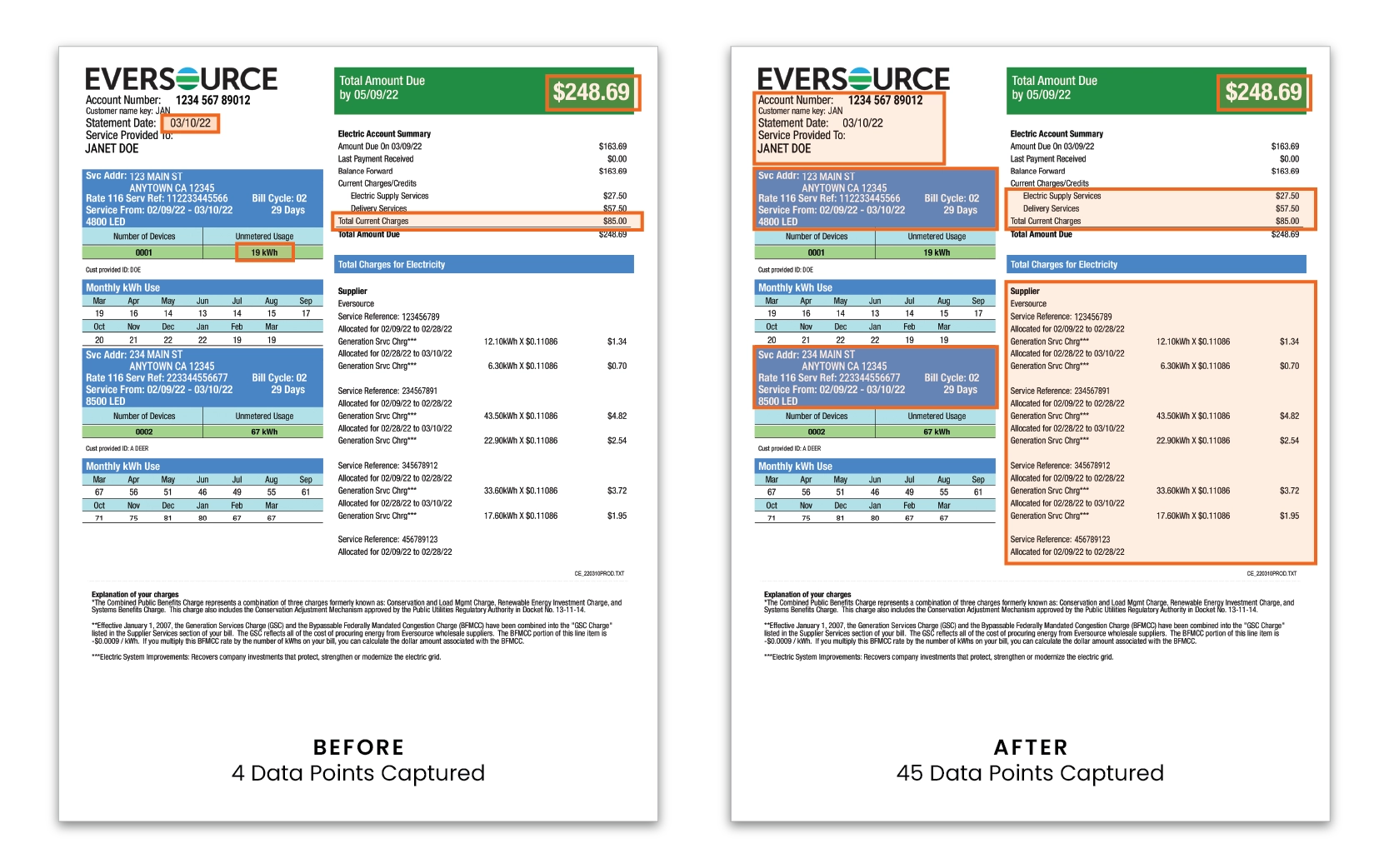
Just a few years ago, sustainability teams had a single mandate: Report. Only four data points were needed: How much energy or water was used, how much it cost, when it was used and the calculated emissions.
Now, sustainability teams must create business value. For example, with rising energy costs everywhere, sustainability teams are now charged with finding energy savings. They have the data, right? In fact, to answer the key business case questions — Where should action be taken? What is the payback of an investment? — sustainability teams need a lot more data. Consider the cost of electricity, which is rising everywhere. To build a case for energy-saving investments, teams need to answer: What is the business case for energy savings investments? Where should this action be taken?
Simple four point data sets simply can’t handle the complexity of how energy is priced, and how usage drives costs. Sustainability teams need more detailed data to build a reliable business case. They need granular data, at the meter level and line-item charge detail structured to quickly identify and calculate the exact amount of cost reductions.
An automated data service has the capacity to capture exponentially more data from every invoice.
In a recent customer engagement, GLYNT.AI increased the number of data points per file by 15X. The customer used the data to pinpoint the key 30 meters out of 3500 total meters that could deliver a high energy-saving ROI. The result was $9 of energy savings per $1 spent on automated data services.
Takeaway for finance teams: The header information on an invoice is just enough to pay the bill. But to build the business case for savings, get all the usage and cost data too.
SAME SOURCE FILE, 15X MORE DATA POINTS
#3 Make Apples-to-Apples Comparisons with Finance-Grade Sustainability Data
To drive business value, sustainability data must align seamlessly with existing business data and decision-making processes.
Here’s a frequent scenario: To win over a key customer, the sales team asks the product manager to show the carbon reduction plan for the product. The product manager must review the carbon content of all inputs, and the carbon added when the product is made. Looking for reductions, the product manager must make tradeoffs: How much should be spent to make that reduction? The business decision requires comparing the cost of change against the carbon reduced. Financial accounting already produces cost per SKU, sustainability teams must deliver emissions by SKU in the same format and timeframe.
Or consider the standard corporate need to forecast revenues, costs and profits. Now planning teams want to add in forecasts of energy costs, emissions, and emissions reductions.
Only finance-grade sustainability data, structured, validated, and fully aligned with business reporting standards can do the job. While spreadsheet-based workflows follow simple linear steps, finance-grade data is produced by a rigorous system with multiple layers of calculations, tests and controls. The system is run by software code and the code can be updated with lessons learned, increasing accuracy and reliability month after month.
Takeaway for sustainability teams: Business impact is a key mandate and it requires better data. Use sustainability data that is as rigorously prepared as financial data.
Takeaway for finance teams: With the rising cost and risk of climate change, this type of business tradeoff will be ever more frequent. Good decision making and risk mitigation requires finance-grade sustainability data.
#4 Use Timely Fresh Sustainability Data That Aligns with the Corporate Calendar
Long before the sustainability function entered the scene, companies set up annual review calendars for strategy formulations, budget proposals, and investment decisions. Today these processes are routine and teams across the company have learned to organize their activities to the annual corporate calendar.
Similarly, sustainability teams must align to the corporate calendar. Business decisions to reduce energy, water or carbon must be made on the same corporate schedule. Sustainability data must be ready at the right time. The finance function does not want to delay decisions waiting for the sustainability teams to finish collecting data.
Example: Data centers use quite a bit of water, driving concern about water cost and availability. To save water at a manufacturing site near a new data center, the sustainability team has found three projects that need approval. The projects will be reviewed by the committee on August 1, and the business case must be submitted July 15. The sustainability team starts work in May and plans to do a last-minute data update on July 13.
Without fresh data, the team will be forced to use sustainability data from last year. The finance team will find this quite odd. To have a seat at the table, the sustainability team needs fresh, accurate data, just like what finance function has.
Takeaway for sustainability teams: Business impact requires alignment with the corporate calendar. Be ready with an automated data service that delivers the right sustainability data at the right time.
Takeaway for finance teams: There’s no need to compromise. As you review investment plans that reduce water, energy and waste, an automated sustainability data system will deliver the fresh rigorous data you need.

#5 Make Better Business Decisions with Added Business Data
Surveys show that market leaders are using sustainability data to reduce key costs to manage business risk. Despite the politicization of ESG, companies are investing in data systems, and making corporate decisions that incorporate climate costs and risk.
Sustainability teams can support these new processes by insisting that sustainability data be integrated with business data. Metadata is data about data, and business metadata includes site codes, payment transaction IDs, vendor IDs and so on.
When sustainability data is linked to business metadata, powerful questions can be easily answered: What is the level of energy use at our high-profit sites? Which vendors produce the most emissions? Which products are the most carbon intense? These straightforward business decisions need business data married to sustainability data.
Takeaway for finance teams: Insist on the business data integration. The value back to strategy, capital budgeting and forecasting is enormous!
Bonus value: AI researchers have found that metadata reduces AI errors (aka hallucinations). Be an AI-readiness leader by integrating business metadata with sustainability data.
Sustainability teams have started on this path, as most include site identifiers in sustainability data. But take this further, include AP records, master vendor IDs and so on. Then other business teams and top management will turn to the sustainability team as the “source of truth.” It doesn’t get better than that!
Next Steps
GLYNT.AI is a self-contained finance-grade sustainability data service. No developers required. Deliver more impact while saving time and money.
Talk to GLYNT.AI about accuracy, reporting and business impact. Our data is ready!
Resources

Finance-Grade Sustainability Data
Read the Guide

Guide to Utility Data
Read the Guide

AI with Lower Emissions
Read the Guide
Contact GLYNT.AI

(650) 386-6392
ABOUT GLYNT.AI
Resources
© 2026 GLYNT.AI, Inc. | #changinghowsustainabilityisdone | Terms of Use | Privacy Policy | Site Map